In a stirring address to the Australian Parliament on 5 March 2026, Canadian Prime Minister Mark Carney declared Canada and Australia “strategic cousins” – a vivid phrase that encapsulates not just bilateral affinity, but a blueprint for deeper collaboration among like-minded nations. Amid a fracturing global order dominated by superpowers, Carney’s visit to Sydney and Canberra from 3-6 March signalled a bold pivot: middle powers banding together to secure prosperity, sovereignty, and security. This wasn’t mere rhetoric; it was backed by concrete announcements on critical minerals, defence, and artificial intelligence (AI). For advocates of CANZUK – closer ties between Canada, Australia, New Zealand, and the United Kingdom – Carney’s words and deeds offer tantalising momentum.
The Cultural and Institutional Bonds That Unite Us
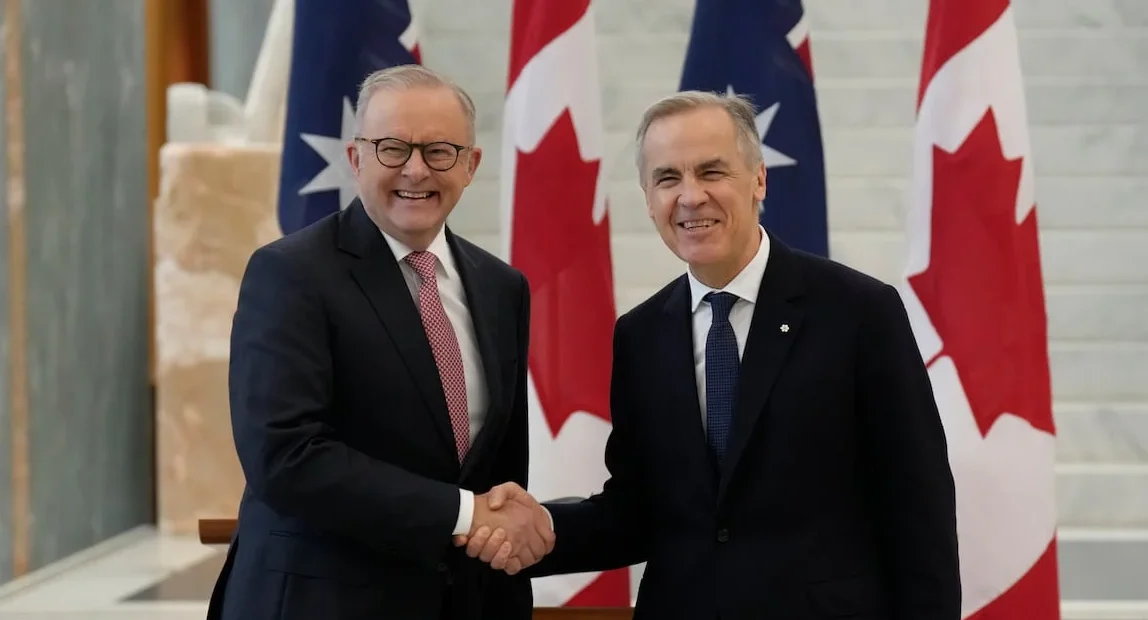
Carney’s trip, the first bilateral visit by a Canadian Prime Minister in nearly two decades, came at a pivotal moment. Fresh from landmark deals in India, he landed in Sydney amid geopolitical turbulence: US President Donald Trump’s tariff threats, China’s economic leverage, and escalating Middle East tensions. Meeting Australian Prime Minister Anthony Albanese, Carney reaffirmed the “enduring alliance” between Ottawa and Canberra, two federations with shared Westminster traditions, resource-rich economies, and a history of standing shoulder-to-shoulder in conflicts.
The highlight was Carney’s parliamentary speech, where he evoked the “global architecture breaking down from consecutive crises.” He urged rejecting competition in favour of “strategic collaboration” – boosting investments, supply chain resilience, and strategic autonomy. Albanese echoed this, welcoming Carney with tales of Canadian “rebels” shaping Australia’s past, from exiled rebels building roads to gold rush unionists designing the Southern Cross flag.
Groundbreaking Announcements
The visit yielded a cascade of pacts, elevating the partnership across key domains:
Critical Minerals: A Democratic Powerhouse
Australia joined Canada’s G7 Critical Minerals Production Alliance, creating “the largest grouping of trusted, democratic mineral reserves in the world.” Together, the duo produces 34% of global lithium, 32% of uranium, and 41% of iron ore – essentials for batteries, nuclear energy, and AI hardware. A new Clean Energy Partnership will catalyse trade, scale technologies, and modernise grids. These moves counter China’s dominance, ensuring resilient supply chains for green transitions.
Defence and Security: Five Eyes Fortified
Endorsing the Five Eyes intelligence network (Canada, Australia, UK, US, New Zealand), Carney hailed it as a beacon amid chaos. Practical steps include training Canadian forces on Australia’s Arctic Over-the-Horizon Radar from mid-2026, aiding NORAD modernisation. Discussions launched on a Status of Forces Agreement to ease troop movements, alongside streamlined procurement, IP sharing, and co-production. Coordination ramps up on cyber threats, Arctic safeguarding, and disaster response – vital as Canada diversifies from US-centric spending.
AI and Innovation: Sovereign Capabilities
An MOU on AI Safety fosters expertise-sharing between institutes. A trilateral with India under the Australia-Canada-India Technology Partnership advances AI deployment, linking industries and SMEs. Pension fund MOUs promise billions in cross-investments, with Australia’s IFM eyeing $10 billion in Canada. Tax treaty modernisation will turbocharge two-way flows.
These pacts, detailed in a joint statement, underscore pragmatism: focusing on controllables like alliances over lamenting lost multilateralism.
The CANZUK Connection: Beyond Bilateralism
While Carney avoided the acronym, his vision screams CANZUK. “Strategic cousins” is CANZUK sans label – four Anglosphere democracies (adding UK and New Zealand) united by language, law, and values. Critical minerals form a CANZUK economic pillar: the quartet boasts vast reserves, complementary processing, and trusted markets. Five Eyes is its security bedrock, now evolving via defence interoperability.
This complements Conservative Leader Pierre Poilievre’s fresh CANZUK push in London. Just days prior, at the Margaret Thatcher Lecture, Poilievre pitched a “modern CANZUK” for free trade, mobility, and security – excluding volatile US ties under Trump. Carney’s actions provide Liberal buy-in, bridging partisan divides. Australia-Canada as a “model” paves inclusion of UK (post-Brexit eager) and New Zealand (resource synergies).
CANZUK International hailed the speech as “crucial” for four-nation integration, building on AUKUS and Five Eyes. With combined GDP over $6.5 trillion and trade $3.5 trillion, CANZUK could rival blocs like CPTPP.